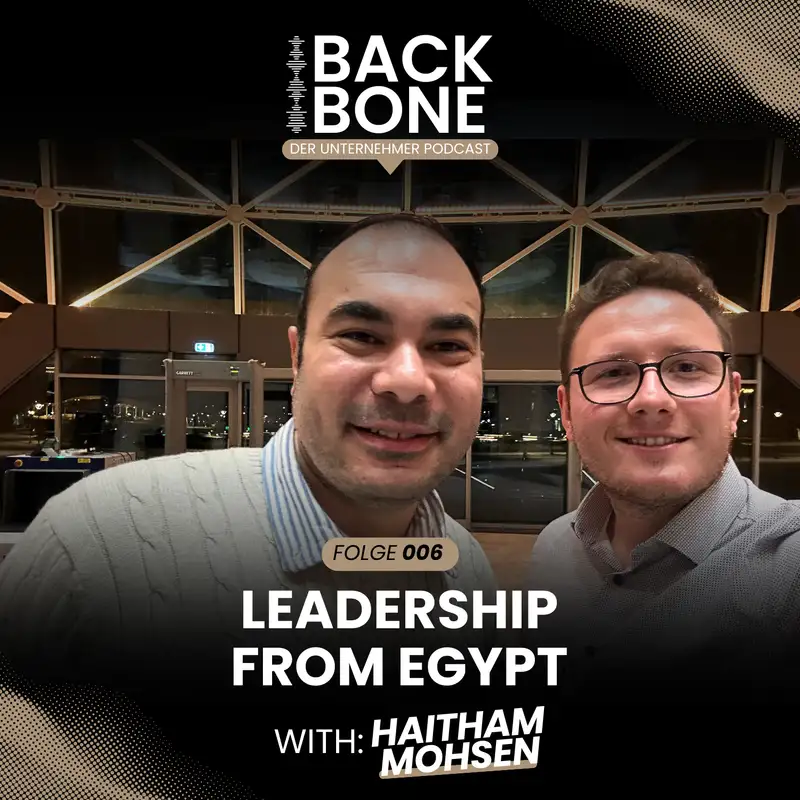
BACKBONE #006 – Leadership from Egypt: Culture, AI & Building Fortec | Haitham Mohsen
(0:00 - 5:58)
Yeah, hello. Hi Haitham, nice to meet you here in my podcast Backbone, which is focused on entrepreneurship and career and also leadership and I'm really glad that you are here. Maybe you can start with a short introduction, tell a bit about yourself, what you're doing, what should somebody know about you.
First of all, it's a pleasure being here with you. A short introduction, let me say that I started my studies with a graduation from Electronics and Communication Engineering, did my master's in wireless communication and information technology and capitalised on that with an MBA from IE Business School in Spain. This is on the educational side, on the professional side.
I worked for, I think, 10 years in a huge operator, mobile operator here in Egypt. It's an international company and then switched to the governmental sector and now I've been with Fortec Egypt or Fortec Group in general for the last two years as the country manager or the regional country manager responsible for building the company here in the startup phase and hopefully expanding on that later. Sounds quite interesting.
Thanks a lot for your short introduction. Maybe let us get in a bit of a different area. Where were you in the past, the point where you realised you want to work in technology or in innovation? At that point in your youth? So basically this started early when I started my undergrad, when I was studying Electronics and Communication as I mentioned.
I realised that it's not just about building or like understanding mobiles or stuff like that. It's about how a solution, you can bring a solution into the market that would ease a pain point or relieve a problem either for a normal customer like a B2C or even a B2B like an industry in general. So this is how you leave a legacy for the next generation to support it either in the infrastructure or even in a day-to-day work environment.
So this was really amazing for me and I really wanted to contribute to that. Yes, so what I'm hearing here is this kind of idea of having an impact for good development of the country but also this fun of getting in touch with new things and this innovation. And see the impact of it on the rest of the people.
Yes, that's true. When you are looking back, were there moments which helped you or kind of milestones how you're leading today the team here as country manager for Fortec? So this is a good question. So I think that what affected my leadership style is back when I was working in a huge hierarchical company.
You know, hierarchical companies come with a price I would say. We were leading. I was one of the team members in a group where we were leading a huge project about replacing old technology with new technology.
It was a huge directive and we tried to work on that in a certain deadline. But this is when I realised that a certain kind of management or micromanagement are not the best styles to go to move forward. Because yes, we have one goal and we need to reach it there.
But you don't need to restrict how the people on the ground do it. Because if you leave them room for creativity and at the same time they know the terrain better than you, as long as they are going to the right goal, then leave them to do their own things. You will be surprised with the kind of results they would get.
And that's what I tried to do in my management style here in Fortec. Quite interesting. Also what you know now in the talk together with Uli, which was before your talk, we were also talking a lot about duty.
So that also your employees that they can do their own decisions but are also responsible. Yes, basically giving them accountability. When you give an employee accountability and room for decision making, it's not just they are doing a work.
It's like I'm doing something that I believe in and I want it to succeed because they have a stake in it. This was my decision to move forward. So I need to prove myself.
And this will always benefit reaching the end goal faster in an optimal way. Because everybody, and that's human nature, is trying to prove that he's doing the right thing or he's thinking in the right way. So if you give them the room to do it, they will do it in a manner that is better than you ever expected.
Yeah, and what also Uli mentioned was quite often with 80% it's working good, with 20% it's maybe working not that good. But then we focus on the 20% and not the 80% who did it quite well. Yeah, that's honest.
There's 100% honesty there, 100% German honesty. I don't know. Yeah, that's true.
Because with the 80%, it usually goes in the right way. But with the 20%, sometimes the idea here is to get balance. Yes, you are taking your own decisions.
But at the same time, you are listening from people with experience, more experience or more bird's eye view. Because if you are in you're doing your own thing and focus on a and don't like to take any extra or small criticism, or you feel offended by it, then you are not learning from the experiences of the people before you. Where it might lead to a stuck point where you are stuck and you're not reaching the right goal.
(5:58 - 6:24)
The key here is to be open, do your own thing, but open also for support and external criticism. Absolutely. And also the question, where does the criticism come from? Is it somebody who is experienced, who did kind of steps before you, which is good criticism, except also somebody who has no knowledge and only criticising you because he's maybe mad at you or whatever.
(6:24 - 7:01)
Yeah, that's true. But I also have another perspective about this. When you get the especially from a technical partner or a technical experience guy, this pushes you in the right direction.
But also criticism doesn't always mean that you're doing something wrong, by the way, because people have different backgrounds, different and diverse experience. So if somebody is looking from a problem from an engineering perspective, he has a technical background. But if somebody else is looking at it from the marketing perspective in general, the sales perspective, he might bring you to a point that you are missing because of a different background.
(7:01 - 9:06)
So you need to take the good from the criticism and evaluate it. And if something is not pushing you in the right direction, you can leave it. That's what I like to do.
Learn from everybody, because everybody at least has one valid point. Also this different kind of perspective. Yes.
And I think the winning strategy here is using diversity and leveraging it into getting a better result, not using it as a negative way. When you're looking now back over the past years, what was the hardest decision for you in your career? Actually, I think there are two hardest decisions in my career. So as I mentioned, I used to work in a mobile communication.
So for the last 10 years, it was a huge company with huge hierarchy. And I'm the kind, I don't know, maybe this is a disadvantage or a negative. I'm the kind that get emotionally attached to the company I'm working with, because I really believe that this is my company and I need to make it better somehow.
So I took the decision to move and switch. I pivoted from communication, mobile communication into electronics. And that's when I joined ITIDA in the public sector, because it was really, it was after my MBA.
And I thought this is the moment where I need to do something entrepreneurial a little bit. And there was this kind of initiative, which is called EME, Egypt Makes Electronics. And they were trying to build the electronic ecosystem from the ground up with the support of the government.
I thought this would be a great idea to do that, especially with the backing of the government. And I don't know if it's a similar in Germany, but joining the government is like the cushion job or something like this. You are safe and you're doing something that you like.
So this was, wow, I hit the trifecta. The risk came when I switched again and pivoted into the private sector with Fortec, because I was doing a startup. There's a lot of uncertainties and a lot of risks.
(9:06 - 11:07)
So I'm leaving a cushion job or a cushion governmental job into the unknown. But I have to say that every risk comes with a reward. And the more the fear is, I don't like to believe that, yeah, I don't like the fear to hinder the decisions.
I really want, I usually analyse the situation, study and try to make calculated risks, if you understand what I mean. And that's when I decided this is something I love. This is something I studied for.
I believe in the company and I know I can do it. And that's why I pivoted again into joining Fortec as well. Yeah, quite interesting.
For me, there's always one question. What is the worst thing that can happen? In the same direction like you were thinking, because it helps you to think about what is the risk. And there's no big risk, why should I do it? Why should I not get an action? Yeah, but the problem is, the higher the risk, I think the higher the reward.
So I hope that fears... Yeah, there's a connection. Yes, there is a connection. And yeah, I actually see the rewards right now, because what I'm doing is really fulfilling to me, because I always, even in my studies, I studied entrepreneurship, and this is allowing me to fulfil something that I always wanted to do.
So yeah, I'm actually enjoying it. I did fear, have the fear in the beginning. You know, that about the, there is like, can I do it? Will I be able to? There are challenges.
Will I be able to overcome them? But when you start and the cycle gets going, or the ball rolling, you just forget about everything and focus on the target. And then you grind, grind, grind, and this will lead you to what you want to do. Yeah, I'm fascinated of your spirit currently.
It's quite good. I like when the talks are getting such deep. It's always for me a pleasure.
Yeah, it's a pleasure here as well. And I'm actually open. I didn't know that I will open up like this when we are talking together, but yeah, this is also amazing to me as well.
(11:07 - 16:58)
Yeah. When we are now looking on your personal skills, are there skills you had, which helped you to get better in leadership? Basically, I would say the skills that helped me the most was two things. I would say cultural understanding and strategic thinking.
So basically, let me elaborate on this cultural understanding. So you're trying to open, for example, in Fortec, you're trying to open a branch for a German company with the German mindset in Egypt, which is totally different culture. If you impose the culture copy paste, it's not going to be able it's not going to work because there's going to be friction and pushbacks.
The good idea here is to understand the culture here and there and try to be a bridge to bridge the gap and connect both cultures. Strategic thinking is related to you have to be also, I think, taking decisions based on facts. And this is what I talked about, minimising the risks.
A lot of decision has to be made, fast decisions, especially in the emerging markets like Egypt. And we need to be frugal. We need to be cost saving and to push forward.
And that's where the facts and the numbers will help you take those decisions and push you even further. And that's the two key, I think, traits that I try to use in my leadership style here in Egypt. When we are now looking back at your MBA, is it also supporting you in your today role as leader? Definitely.
So basically, when I wanted to do an MBA, I was searching for a lot of options and I figured that IE Business School in Spain was the best fit for me because it has a focus on two things. The first one was entrepreneurship and the second is diversity. So entrepreneurship, everything was when we were studying, they always tied it back to entrepreneurship, creative mindset, how to leverage ideas and different ideas, because different is not always bad.
Different is unique somehow. And you're trying to enter the market from a different perspective, which is always a good idea because it opens up a multitude of opportunities. Basically, this is entrepreneurship.
And that's what they tried to build in us when we were studying everything regarding finance, supply chain, even startup mentality as well. That's the first thing. The second thing is diversity.
They really focus on diversity and how diversity can impact or enhance the outcome of any situation or any project. So basically, let me tell you a small example. So basically, in our classes, they divided us with not only different backgrounds, like cultural backgrounds.
So basically, you'll find an Egyptian in a group with an American in a group like with a French guy, with a German guy. They tried to bring all different nationalities to incorporate different cultures working together. Not only that, they also diversified the professional background.
So the Egyptian would be, for example, an engineer. The American would be working in sales. The German would be working in avionics.
And because they believe that as I mentioned, different perspectives, different cultures, different professional backgrounds will always give you more perspectives and totally unexpected results. So that's actually affected 100% my management side and my way of thinking about everything, especially leveraging diversity because diversity is always a positive if you are treating it right. Quite interesting.
When we are now looking to a young leader, a young entrepreneur, what would you maybe give him as advice for the emerging markets? Yeah, I think advice would be focussing on two things. Again, technology is now essential. So they should be technology literate.
So basically, for me, I had the luxury of being an engineer. I studied about electronics and communication. So in order to be a young leader or operating an R&D centre, I don't know everything because nobody knows everything.
But at least I know or push them in the direction that's going into the goal that we need. And the second thing is, again, as I mentioned, numbers. If you are leveraging numbers and analytics, this is going to push you in the right direction.
So if you capitalise on technology, when I say technology, it's like understanding the new technology, groundbreaking technology, thinking of something new. Plus, now we have the AI. And AI, some people would fear it, but I actually believe that AI is helping, not something to be feared.
It's something to be utilised to minimise, for example, research time, push people to the results in a faster way. It cannot do this on its own, but it's really essential and it will help boost us for the future. Yeah, one small interruption, I think it's a quite good point.
There will be this dividing between people who are using AI and getting good results and the one which are not using AI and having not that fast, that good results. And so the one which are using it will like overtake the ones which are not using it. Yeah, I do believe that this is again out of fear.
(16:59 - 17:14)
Why are we not using AI? What's the worst thing? People are fearing that this might replace us or the AI is learning because AI, you know, it's a basically learning machine learning model. So it's learning from what we are doing. We are feeding it and we are making it more smarter somehow.
(17:14 - 21:27)
But the ground decision or the final decision goes back again to the engineer or the one using the AI. And how are we using it? Either in speeding stuff up ethically, how are we using it? And this is how we should leverage technology. Absolutely.
If you think back, we used to search about ideas in books later. We used the internet because this opened up a huge Pandora's box about research for everything. You can access the internet from that.
Now, the next thing is AI. If you are not using it right now, you're going to be missing out for the next couple of years because people are using it. And there is no denying that.
And you're going to be left behind. Yeah. Also, a funny fact, also AI helped me preparing the questions for you.
Really? Yeah. Oh, that's good. That's good.
And yeah, because AI always, I think it's a good thing to use because it's a tool that's available there. And if you're not using it, you're lagging. So again, instead of fear, let's do calculated decisions and study it, know how to use it correctly.
People now are using it. I think we are still in the learning phase because we are starting, but there is a huge amount of science behind it. How to do the prompt, how to do it somehow to leverage the best results.
And I think this is going to be a huge thing in studying because some people would believe this will replace me. I don't think so. Because the key in knowing how to utilise it in the right way to push yourself in your career.
I think this is the right way to say it. If I'm not correct. Absolutely.
Now I would like to do a small switch. Again, we talked before about perspectives, talked about diversity. And now I will switch a bit in the field of working between cultures.
What do you think, what is the biggest difference between working in Egypt or with Egypt workers and compared to German or European teams? What's the biggest difference? That's a good question. As I mentioned, this also falls in line with diversity. So as I mentioned, every kind of culture has its own advantages.
And the key here is to be, as I mentioned, culture understanding. So let me give you an example. What's the advantage of working in a German environment? I would say the rigorous amount of planning for the future, understanding the market, the kind of technical specifications and building a product that will live for long term.
So this is kind of reliability that you get from the German market. And this is the benefit you get from there. On the other hand, what will you get from the Egyptian market? So the Egyptian market is built different.
It's built along the lines of trust and understanding the partners or the people you are working with. And at the same time, the kind of flexibility. We are very flexible because the market here in Egypt is very dynamic.
So if you don't change, you will die. And that's the kind of thing that's been wired in the DNA of Egyptians. They need to be very adaptive to solve problems.
So the kind of thing advantage you get from Egypt is adaptability and always thinking in a way to solve the problem with minimal cost, I would say, and the fastest way to do it as well. So if you combine both these things, you will get rigour and resilience. So because you're building a solution for the future and at the same time, if you're facing any problem, you can use the agility of the Egyptian team to move forward as well.
Are there maybe kind of misunderstandings between Germans and Egyptians? Yeah, you're trying to get me in trouble. Yeah, of course, of course. I would say this in a non-offensive way.
(21:27 - 22:45)
But this again, based on culture, like, for example, I will give you a small example. And this is where I try to mitigate and try to solve this kind of thing because I'm trying to act as a translator here. So Germans, we have a perspective about Germans that they are really, as I mentioned, strict and transparent, 100% transparent.
Sometimes, if like, for example, somebody is giving you feedback, they would be really harsh. They are not meant to be rude, but they are giving you the harsh reality, right? This is the best way to do it from the German perspective. On the Egyptian side, they would think that this is rude because they usually don't want to give you the facts 100% like this.
They will try to soften the blow somehow, especially if it's a negative thing. We know this from Switzerland also. Really? Yeah, they have the same thing sometimes.
Yeah. So basically, from an Egyptian perspective, they will try to, first, they will try to solve it on their own and not share this kind of info. And if they are stuck, they will do it, but in a more softened way that it would be not impacting or not 100% in your face like this.
(22:47 - 23:29)
I totally understand the perspectives of both. When somebody is coming, why is he being so rude to me or something like this? What I try to do is explain that he's not being so rude or something. You need to understand that this is a different culture and he's trying to help you.
This is his way of helping you because he's being 100% honest with you because he wants to help you move forward. And at the same time, I'll try to explain to the German side, please try to think a little bit that the Egyptian culture is a little bit different. Try to soften the blow and you can direct, you can give them the message the way you like it, but try to be more sensitive to the feeling because Egyptians are a little bit emotional.
(23:30 - 24:49)
But also, I realised something that I also had to do that for the Egyptians. I had to highlight that if you are stuck in something or facing a problem, you don't need to be trying to do a 360 flips to solve it on your own because you don't want to share it. Because being 100% transparent and sharing everything.
Hold up your hand. Yes. Yes.
Please help me. I need support. This doesn't mean that you are less or you are doing something wrong.
This means that you are a part of the team and he has the experience to help you to shorten the time of the problem or somehow. So I push them to try to be more transparent and at the same time, I push the German side to try to be more understanding. What do the Egyptians do better and what do the Germans do better? I think I touched on this earlier, but I will elaborate on that.
I think the Germans are really good in planning, setting up specifications and coming up with a product that will be very resilient. I think this is built in their DNA. They think 100 steps ahead, how to secure a supply chain, how to do that for the next 10 years, not only for the project to come out and then release.
Quite in detail. Yes. Count in detail.
(24:50 - 28:13)
The details are really surprising. On the other side, Egyptians are more adaptable, agile and frugal. So if you are, if Egyptians are facing a complex situation or a problem, they will try to use their agility.
Let's come up with a solution. Let's do another design. Let's check with another supplier.
And they do this really fast and really, really, very high agility. So if you combine both, I think you got the winning company here. They combine both the long-term resilience and agility, because you have to face the fact the market is very dynamic and you are always faced with unexpected problems.
And if you use this kind of agility with the long-term planning, you're going in the right direction. I'm thinking also about Americans, which are also often quite fast in building up an MVP, getting on the market and getting feedback. That's something that I always say Germans are missing quite often.
It's a bit comparable. Yeah. Yeah.
It's a bit comparable. And also, I have to mention other things. This is also, I mentioned before, Egyptians are really emotional and they always want to build relationships.
And this gives them the insight to understand the customer better. So when they are working with a customer, they are trying to build relation, understand their needs and use their agility in customising existing solutions to better fit the needs of the customer, which is always yielding better results, not even in the MENA region customers, but in general for the global market as well. One last question on this kind of issue, topic.
What surprised you the most when you were working with Europeans? What surprised me the most? I would say that what surprised me the most is the level of detail. Like for example, Germans are really meticulous about everything. Everything they would document, the documentation is amazing.
The level of detail, the kind of financial reports, everything, a hundred percent transparency and the details are shocking. And I really don't know how they do that. And we need to learn from that because they are, I think the gurus in something like this, because they don't miss a detail.
And this is such a thing that they are really, I don't know, like, for example, when they are, if we took an example of long-term planning, as I mentioned, they have the kind of detail not to plan for just releasing a product, to release a product and sustaining it for the next 10, 15 years, for example, which is really essential in some sectors, like the transportation sector, avionics and stuff like that, because they are not changing everything on the go. And this is the kind of mentality where the German products or the German mentality really shines because they know they are safe when they choose German products, they are safe for the next 15 years. And this gives the edge for any kind of German technology over all the world.
I think this is my opinion. Yeah. Let us now again switch a bit.
(28:17 - 30:02)
I also see Egypt as a growing technology hub. So why do you believe Egypt has so much potential in electronics or in the tech sector? Okay, that's a good question. And I'm a little bit biassed, but I will try to be unbiased.
So Egypt actually has a trifecta of benefits that if leveraged correctly, they will serve as the building block or the growth that many companies that need. The first thing is, we have a huge young talent pool. So I think we are 110 million now in Egypt.
And I think 60% is under the age of 30, which is really huge because all this young tech savvy, I would say, young talent, huge talent pool can be used in the market. That's the first thing. The second thing is regarding the costs.
The costs of having an engineer here in Egypt is really very competitive compared to the costs around the world. I'm talking not only about the lowest cost, I'm talking about having a cost of an engineer that will give you reliable work, not just, I would say like normal work, but because of the way the engineers or the Egyptians are thinking with creativity and coming up with ideas, this gives you a kind of work that's not available everywhere in the market. And the last thing is the geographical location.
(30:03 - 30:59)
Egypt is like the connection between Asia, Africa, and also Europe. It's in the pivotal centre of all. So you know that Suez Canal is passing through Egypt.
So basically, I think every kind of component or product is passing through Egypt. If you can leverage that and do some assemblies in Egypt somehow, then you are securing your supply chain and making sure the lead time is low and at the same time leveraging a great, I would say, a partnership, but it's not a partnership. I'm thinking of something else like all the agreements that's been with Egypt and the African countries, agreement with Egypt and Asia, agreement with Egypt and Europe regarding tariffs or regarding taxes or stuff like that.
(30:59 - 31:04)
You're going to leverage this kind of agreement. So yeah, it's a strategic thing. It's really good.
(31:04 - 40:39)
Sorry, there is also something else that I wanted to mention that I forgot. So let's make it four now. The governmental support.
Government support really believe in the electronic sector and they are trying to push really hard to make it flourish here in Egypt. They realised that they have a talent pool that can be used. And how can this affect the overall GDP? So by giving incentives to companies to open here in Egypt and this will, of course, increase the FDI or the foreign investments coming here in Egypt, which is the strategy of the government overall and how it will affect the GDP as well.
Maybe it's also a bit getting in this direction that Egypt is getting the big player in Africa for electronics. Yeah, yeah. So they try to do that by giving them incentives for them to come here and open, let's say a shop, open up shop here and have a branch here in Egypt as well.
So, for example, about giving incentives, I don't think I can mention names, but I would say that Egypt had a very successful example with a huge automotive embedded system electronic company and they gave it a go. And it's not only that they realised that the kind of impact that it had on the market, it changed the brain set or the mindset of the engineers, because if you join the company, work with them, know how they work. The engineers are very ambitious.
So they realised that why not do this on my own? So you realise that a lot of spinoffs, small spinoffs, of course, not similar to the giant, but small spinoffs came out of this knowledge sharing hub, I would say, and they opened multiple companies with Egyptian labour force. And that's when the Egyptian government realised this is the right way to go. It's not only about giving incentives and inviting giants, but it's changing the mindset of the engineers here and how they can approach the global markets.
Yeah, maybe let us get at this point a bit deeper. What must change for Egypt that they are reaching this next step? Yeah, that's a good question as well. So I don't know if you know about the biggest hurdle in Egypt.
So there are two things. The first thing is import and export. So compared to import and export here in Egypt and Europe, I think Europe has it in a smooth way without any hurdles.
Here in Egypt, still people are facing hurdles with customs and how things are moving forward because it's not 100% digitised. It still has a huge man factor or affecting this kind of process. And the second thing is, I think, regarding the currency fluctuations.
This is good. Don't get me wrong. Of course, it's good for foreigners.
But hopefully, if you want to put Egypt in a different way, you need to stabilise the currency. And that's what they are trying to do right now, because fluctuations will always impact how you are calculating the next or forecasting the next couple of years because you're trying to build a budget for a certain number, especially if you're doing it in an EGP. But usually when you are buying components, you're buying it either in US dollars or in euros.
Yeah, maybe it would be a good idea to switch to US dollars maybe. Yeah, that might be a good idea. But again, they are still trying to or maybe you can peg it to a certain currency to a certain kind of dependency.
Yes, dependency. And I think this is what all the Gulf countries are doing. It's pegged against the dollar.
But yeah, let's see. The government is trying to stabilise that based on many initiatives. And I think we are going in the right direction.
I think it's been three or four years since any kind of fluctuations happened. So I think we are going in the right direction in this aspect. Maybe again, more looking on Fortec, why did Fortec decide to build operations up here in Egypt? Do you have an idea why they did it? Yeah, of course, because I was there when they were thinking about the idea.
Fortec has a futuristic strategic vision regarding that they needed. They really realised the importance of having a hub here in Egypt. So first of all, again, they will get access to all the young talent pool that's available here in Egypt, which will help them build their R&D centre.
Two, Egypt is the gateway for the MENA region and MENA region in general. So I mean by MENA, MENA like Middle East and North Africa and even Africa as well. So if you have a strategic hub, logistic hub here in Egypt, you will be able to access all this region that was not accessed before.
So this is a kind of a barrier or a new market which is connected when I'm so the North African and Middle East is all connected by one mother tongue, which is Arabic. And having a hub here will facilitate this kind of conversations, especially when I mentioned earlier that Arabs in general are really having the kind of relationship or having something like somebody talking to them and understand their culture is really important for them to do deals. So this is you are trying to localise it somehow and leverage the local experience in doing such an expansion.
So, yeah, and they realised if they do that, that would be the future kind of way to grow globally. And I think also the last thing would be they really had a good prediction of how they wanted to navigate the geopolitical situation because you know what's happening with the U.S. and the kind of fluctuation that's happening with the tariffs, which is making the market really unstable, especially for European countries. But you will not find this kind of thing happening with Egypt.
So the tariff here is stable and there's no kind of fluctuations because of the geopolitical position of Egypt with respect to the world. So, yeah, this was also something else that they took into consideration and they had future vision. If we did that, we would be able to support to avoid this kind of conflicts.
OK, let us now get back again a bit in the area of entrepreneurship and mindset. Where do you see the biggest opportunities for young entrepreneurs in Egypt? The biggest opportunities? You mean like the sectors? Yeah, they have quite good, it's easy to start and there's a lot of future. I think there are two main things that if you want to talk about the entrepreneurship here in Egypt.
So, as I mentioned, Egypt now is building infrastructures because they are trying to build the country or raising the level of infrastructure everywhere. Not talking about only the real infrastructure like roads and bridges, which you will see there is a huge infrastructure. We are sitting actually in one of the biggest infrastructure, the new capital.
I'm talking also about the digital infrastructure. So any product that's going to alleviate pain or solve a problem regarding a B2B here in this kind of segment, because all this kind of infrastructure needs support from the industry. And if you solve a problem, you find a product that would solve a problem into this kind of digitised era or this kind of infrastructure, you have a winning solution.
And I think Fortec also builds in this kind of thing because our displays and our embedded solutions are really essential in this industrial process or in building the infrastructure like transportation or any kind of stuff. The second thing is, I would say the fintech, because fintech is really huge here in Egypt. If you have an app solution that would make sure that everybody has access instantaneously to money and be able to do transactions, because there is a huge population here in Egypt that doesn't have access to banks.
So if you are able to take all this money and give them access to financial easy transactions, you will be winning in a huge market with people that don't have access to banks and are catering to this kind of segment. And that's why fintech really here in Egypt is booming as well. Quite interesting.
Let us now get again to a bit of personal question. What does success mean for you personally? Okay, success. Success, personally, so basically, the easiest answer would be to say sales and money.
(40:39 - 42:24)
But I believe that it's essential, but it's not the end goal. I think the end goal, as I mentioned here, would be legacy. Let me elaborate on this.
So what I mean by legacy is like, if you were able to get a product out in the market, in the world that would solve a problem, ease a situation, and this will live for generations, then you really build a legacy for yourself, a name for yourself. You leverage technology into solving a solution, either B2C, like if it's an industrial situation, or B2B, if it's an industrial situation, or B2C, if it's just solving a problem for day to day. As you mentioned with the thing that not everybody has an account at the bank.
Yes, this is just a normal problem that's in Egypt and people are trying to find. So this is a legacy. The second thing is, and this is really tied to my entrepreneurial side, if succeeding in building a machine or a system, the company is working on itself.
Of course, I will give support as I can, but I really see a success if the company is working on it. So some people would believe that if the company is working on its own, then I really am a failure. They don't need me, but it's actually on the opposite.
It's actually a success. If the company is working on its own, there is a process and the wheels are running, then you did the perfect job in building the company to be sustainable and moving forward to the future. So these are the two things, legacy and building something from the ground up that will be able to maintain itself and move by its own.
(42:25 - 45:19)
I would add one point, also the family, the kids, the wife. Yeah, so that's actually a good success on the other hand, but not the technical success or not the professional success. Correct.
Having the support and back of the family, this is such a great achievement. And I just actually, I've married like two years ago. Meet this year.
Really? Yes. Yeah, that's amazing. Congratulations.
But this year I would say something, I just have a cute little girl and yeah, this has been an eye-opening experience right now. She's only six months. So yeah, this is something new that I've been missing out, I would say on, but I'm really surprised by the, or amazed by the kind of gestures that you get when you are just a new father or something like this.
Yeah. I can imagine the way of life is changing. Yes.
Yes. The way of life is changing. That's true.
Let us do for our last question again, through in the future. What do you think, what will change in leadership in the next 10 years in your region here in Egypt? Is there change? Yeah, there is change. So I think the change would come from, again, you know what I mentioned, leveraging new things, for example, AI.
So people need to be taking decisions based on facts. So people need to understand how to read these kinds of data and take decisions based on them because the environment here in Egypt or the market is very dynamic. And if you wait and see the market and be reactive instead of proactive, you're going to be missing out.
So if you leverage these kinds of new technologies that are emerging right now, for example, AI, into helping you take this kind of decision, then you are going to be the best leader for the company you are working for because you are thinking of the future. And you need to do that in order to survive in such a dynamic environment. Yeah, a nice perspective for our end.
Thank you very much for this talk. It was quite interesting at a lot of points. Also, I'm looking at our visitors and also our subscribers who are taking part of hearing the podcast.
It's the first one in English. I hope they enjoyed it also a lot. I really hope so.
Yeah. And also they should leave something in the comments. If you have an idea or you want to add something, put it in the comments.
Thanks a lot for coming. It was a pleasure to have you here in Backbone. And thanks a lot also for this warm welcoming here in Egypt.
(45:20 - 45:55)
Yeah, it's been a pleasure having you here. And hopefully you really enjoyed your stay. And I really love that you came here and did the Egyptian experience.
So you did see everything on the ground and you know how things are moving forward, which is different from many people. But I really believe that what you did shows how you care and are really interested in the different market perspectives, which is really makes you unique in your own kind of way in telling the story as well. Thanks a lot.